Signal
Know what changes
Signal is the basis: its profile and legislation are the starting point of your framework.
Starts with the regulatory change teamFrom € 5,500 a year
Cookies. This site does not measure visits and sets no marketing cookies. In your browser we only store your language choice and the fact that you closed this notice. Cookie policy

Direct the change
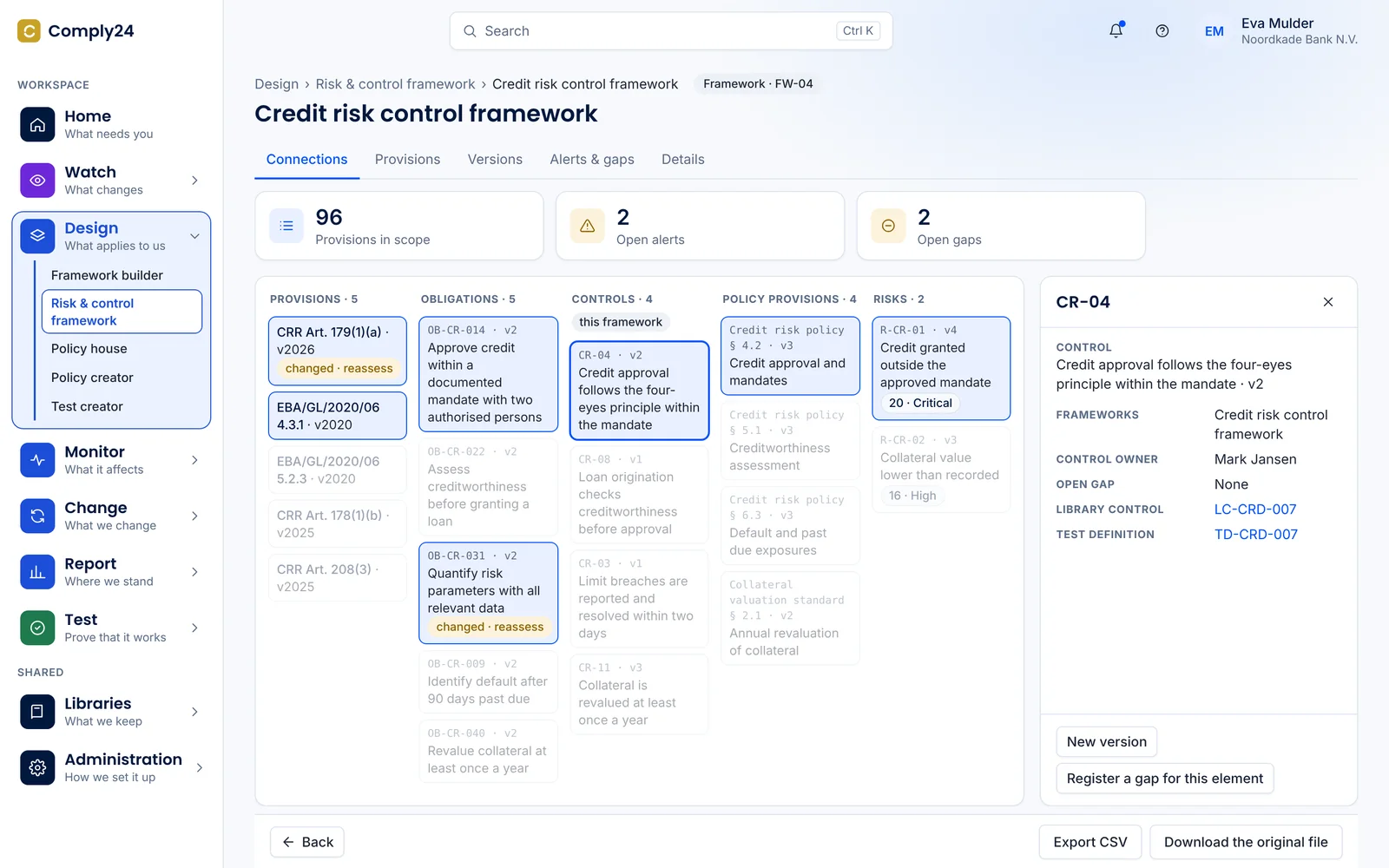
Trace carries the impact of changes in the law straight through to your frameworks. Your control frameworks, control definitions and policies are linked by lineage to the legislation in your scope. You see which change has an impact and make the adjustment in a single step.
What changes
A change in the law
Advisers, a new gap analysis, rewriting documents and a spreadsheet to keep track.
every timeA question from the supervisor
Which control and which policy provision cover an article is scattered across files and mailboxes.
scatteredA choice in the framework
Why something is in or out of scope is known only to those who were there.
not recordedA change in the law
Only the affected controls and policies open up. The rest of the framework stays as it is.
only what changesA question from the supervisor
Obligation, policy provision, control, owner and decision, with name and date.
in minutesA choice in the framework
Scope, priority and mapping are in the platform, with reason, name and date.
lineage to the lawBenefits
Trace records the link between the law and your own frameworks. So with every change you know what is affected.
Article, obligation, control, risk and policy in one chain. For each article you see what covers it and who approved that.
A new version of the law affects only what depends on it. Impact alerts land on exactly those controls and policies.
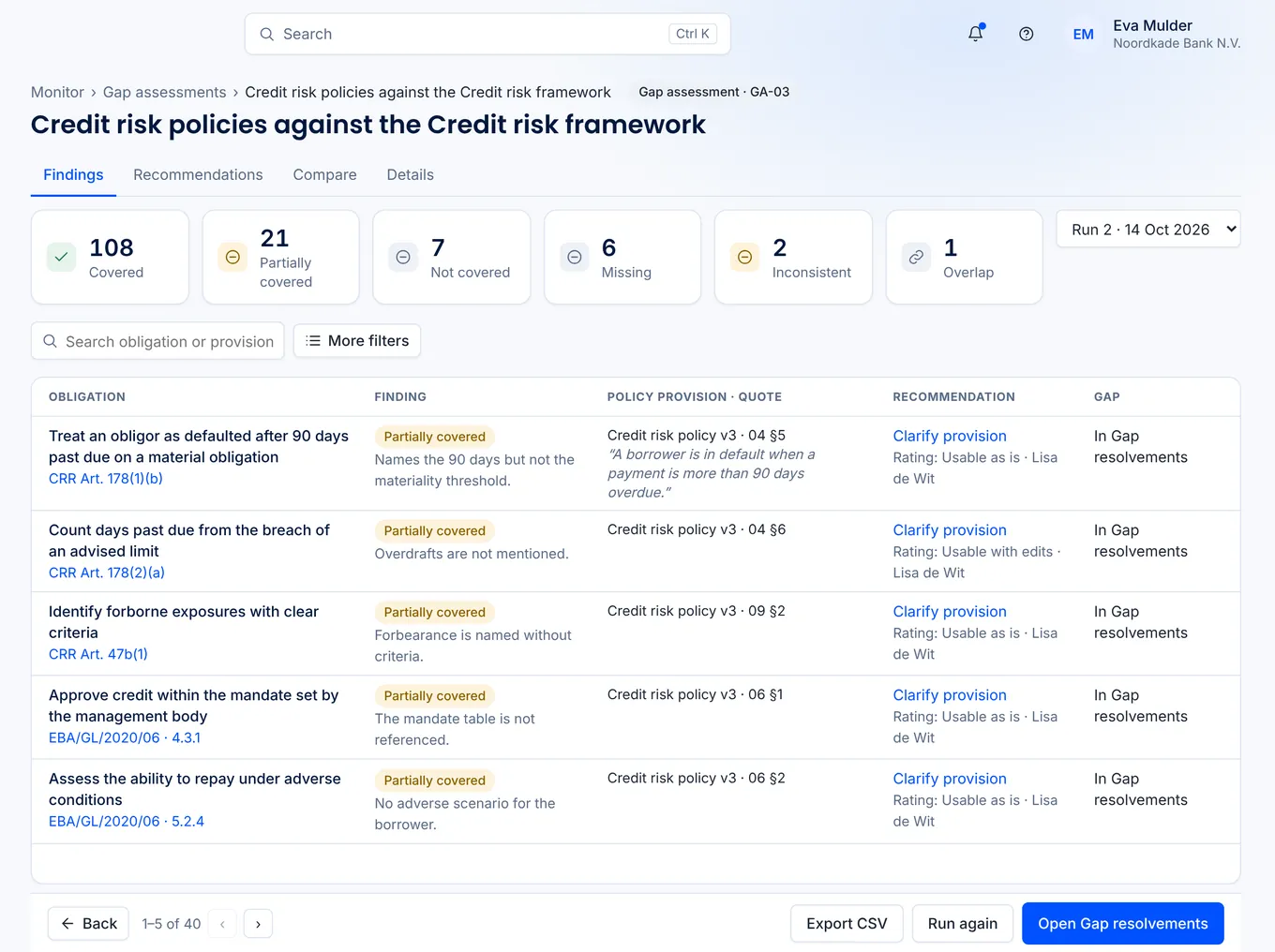
Every obligation tested against your policies, procedures and controls, with the quote from your own document.
Your control frameworks, control codes, policy structure and risk taxonomy stay as they are. You import what you have and link it to the obligations.
One change in the law becomes one gap with an owner, a plan and evidence, across all affected controls and policies at once.
Scope, priority and mapping are recorded with their basis, a name and a date. The second line, the third line and the supervisor can see where each choice comes from.
In four screens
The Framework builder translates the legislation in your scope into obligations. Your experts decide. Every obligation carries the citation of the provision it comes from.
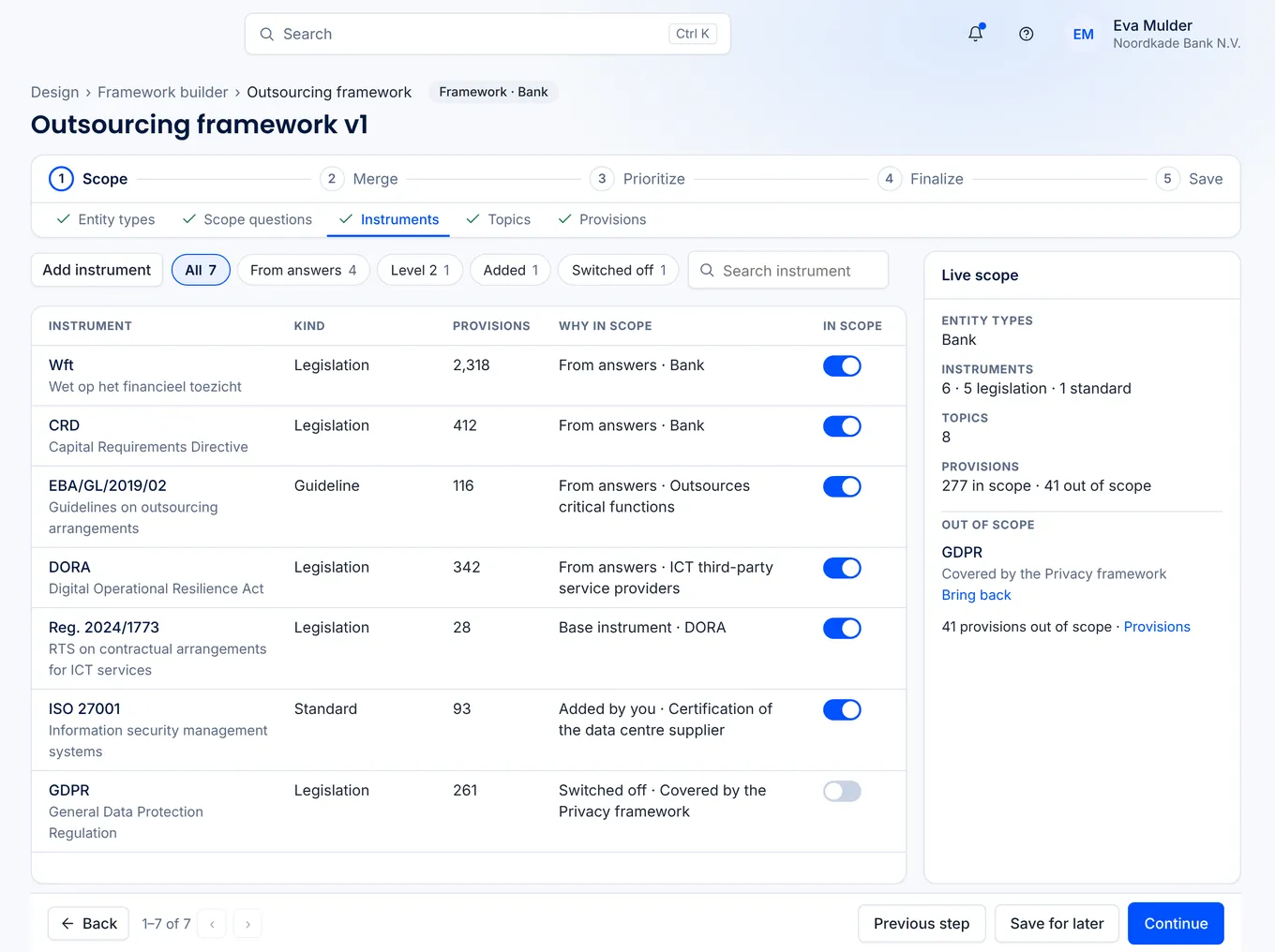
For each instrument, the provisions in and out of scope, with the reason. Your answers on licences and activities set the starting point.
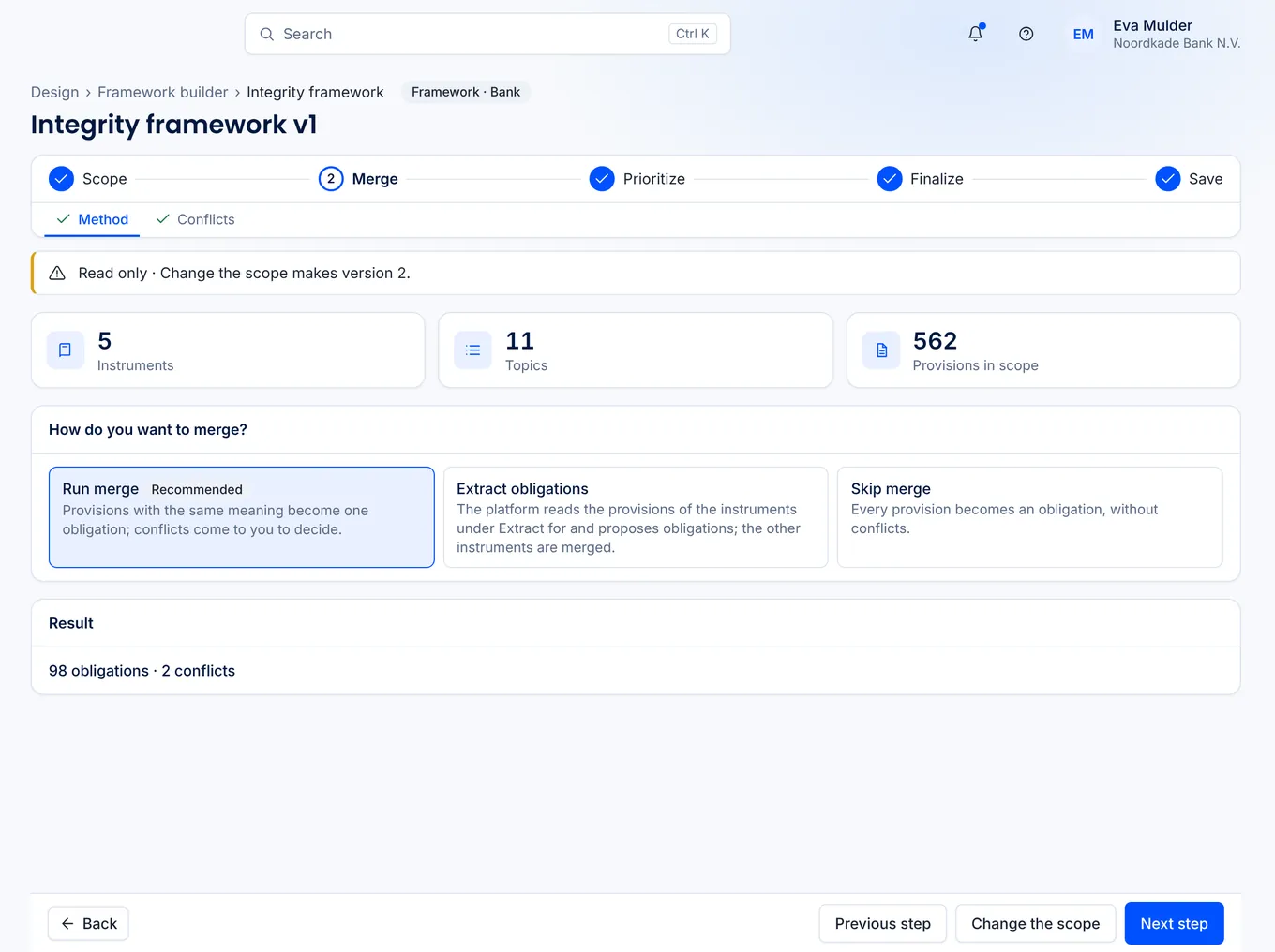
The same requirement from the CRR, the EBA guidelines and the Wft becomes one obligation. The platform puts conflicts to you.
Every obligation gets a priority with its basis. Your expert confirms, edits or splits.
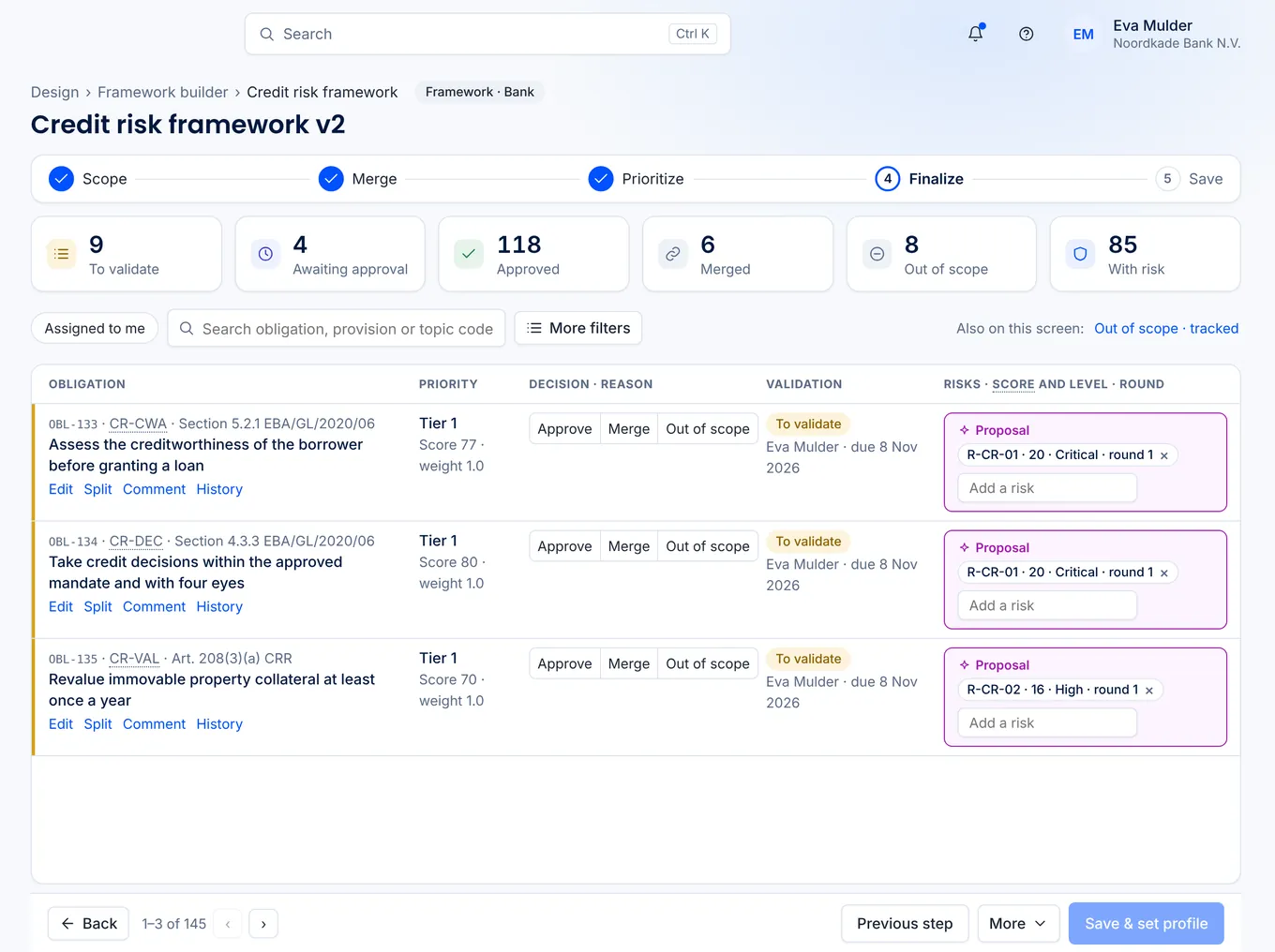
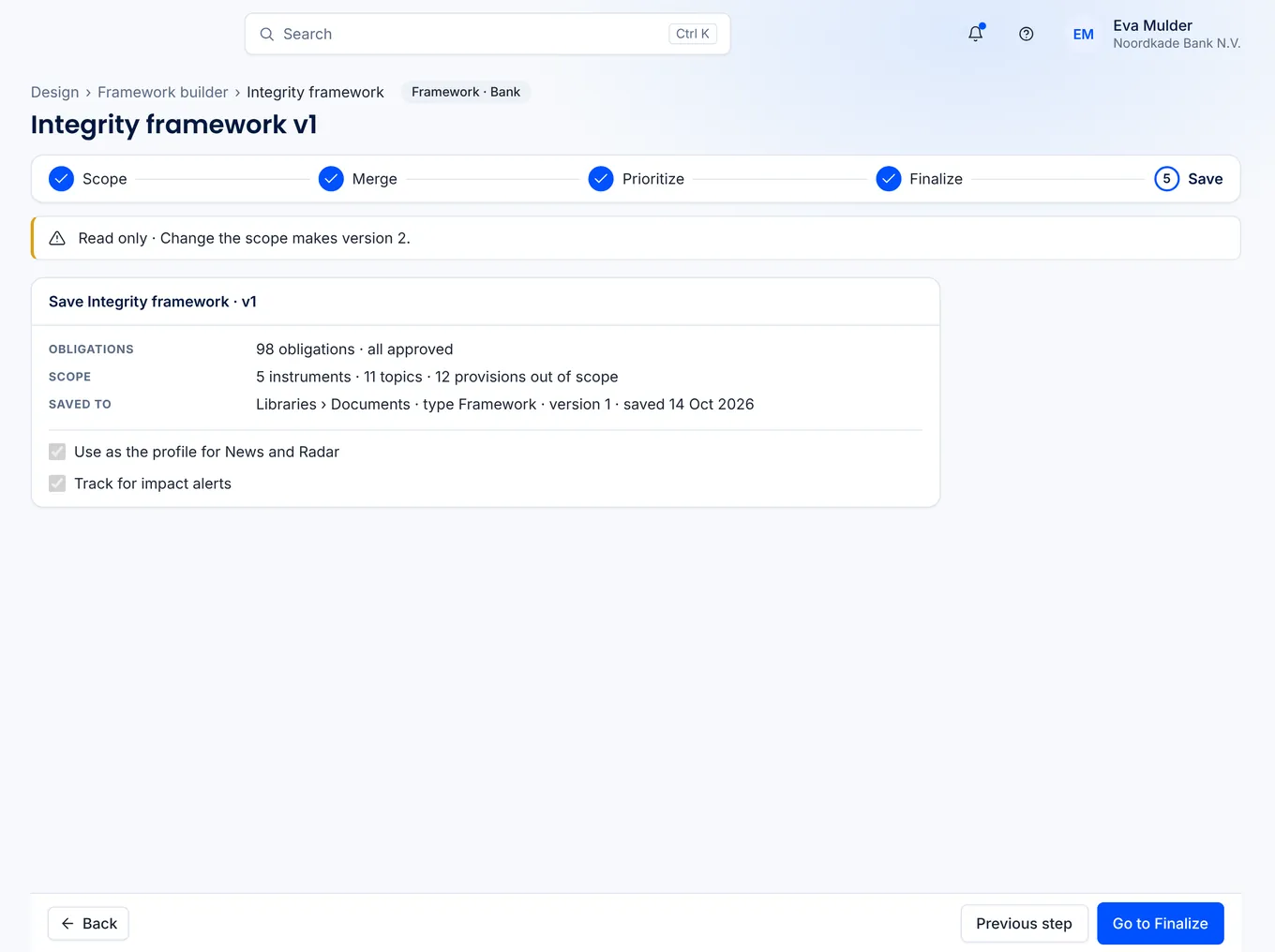
The framework gets a version, becomes the profile for news and radar and is tracked for impact alerts.
Try it
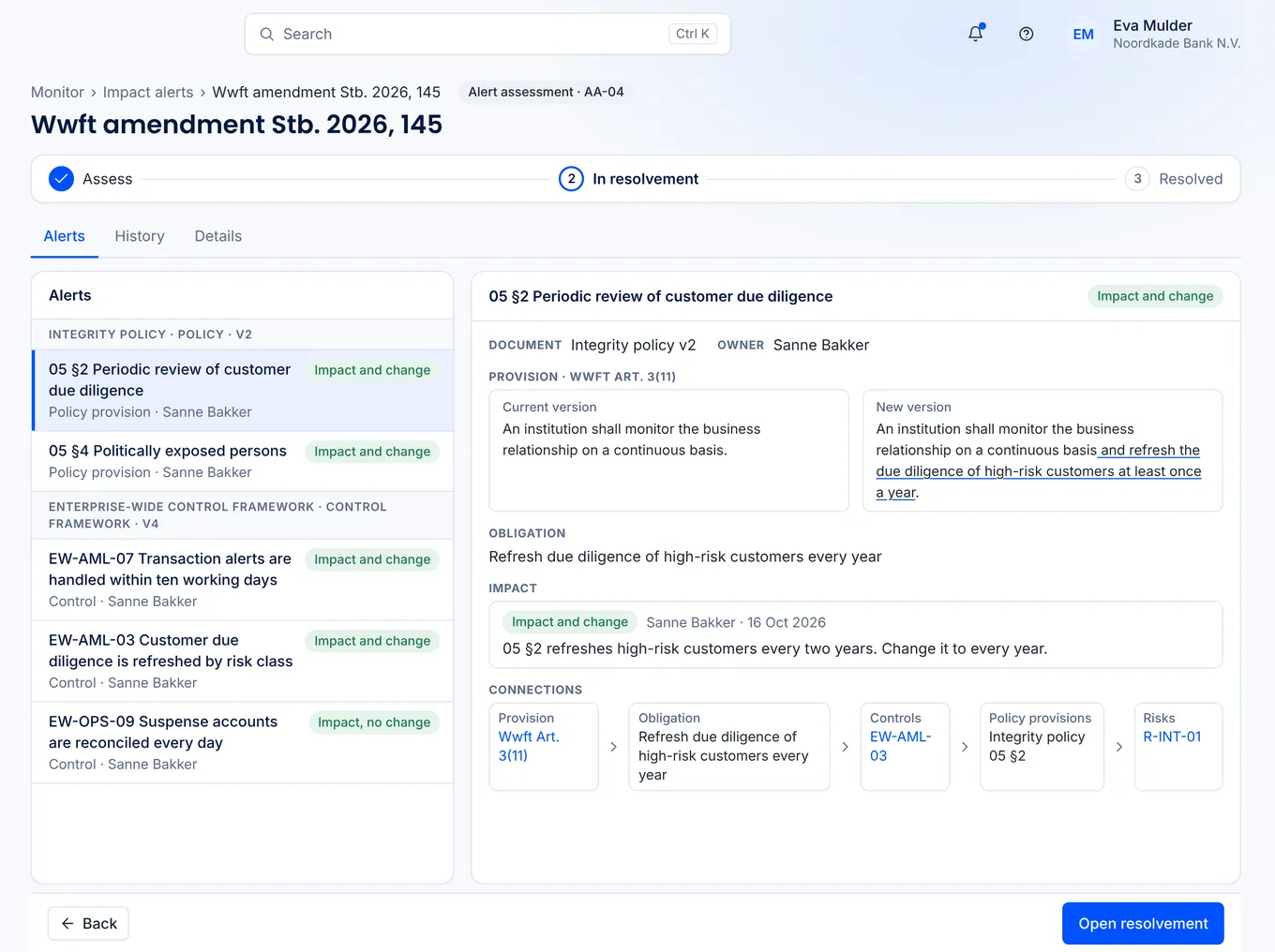
A new version of a provision raises an impact alert on every control and policy that depends on it. The owner sees the current and the new text side by side and decides.
Lineage in view
Click a link and see what is behind it: what was approved, by whom and when.
Swipe sideways for all eight links.
Law
Capital Requirements Regulation as amended by Regulation (EU) 2024/1623. Loaded per article and paragraph, including versions. A new version shows the difference per provision.
Provision
A default occurs when the obligor is more than 90 days past due on a material credit obligation.
Obligation
Derived from the provision with the citation attached, merged with the same requirement from the EBA guidelines and approved by the expert.
Control
The system flags obligors more than 90 days past due. The workout team reviews them within five working days.
Risk
From your own risk register. The gross risk is high. The net risk follows from the test result of the control, not from its description.
Policy
The policy provision that covers the obligation. A new version of the law affects this provision only, not the whole document.
Test
Sample of 25 obligors from the third quarter. Two conclusions, design and operation, and a review by the second line.
Evidence
Recorded with version, source and time. The test report is frozen. From the evidence you can trace back to the article it relates to.
Trace on screen
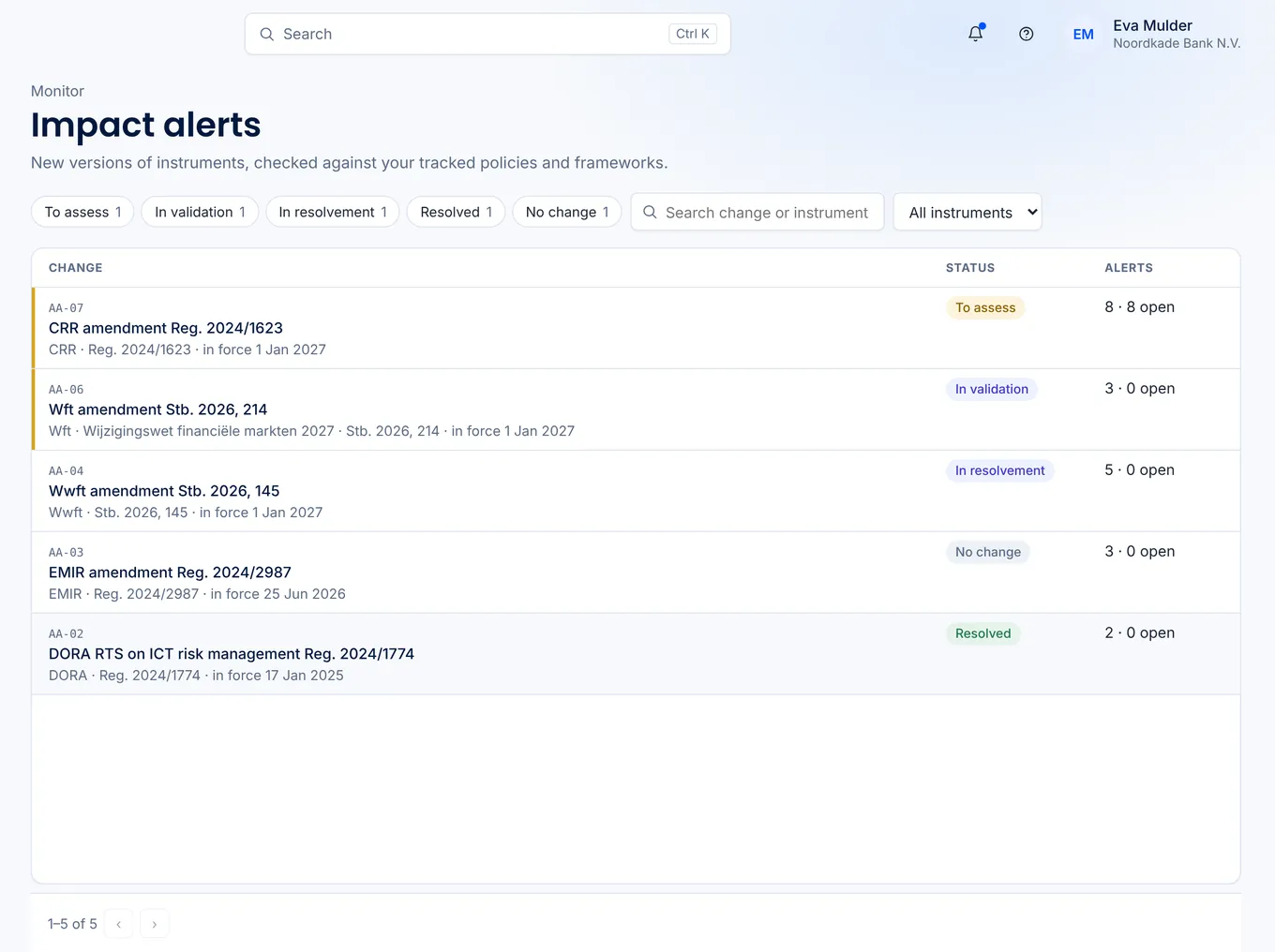
When a law gets a new version, Trace finds which control frameworks and policies are affected. For each change you see the status: to assess, in validation, in resolvement or resolved.
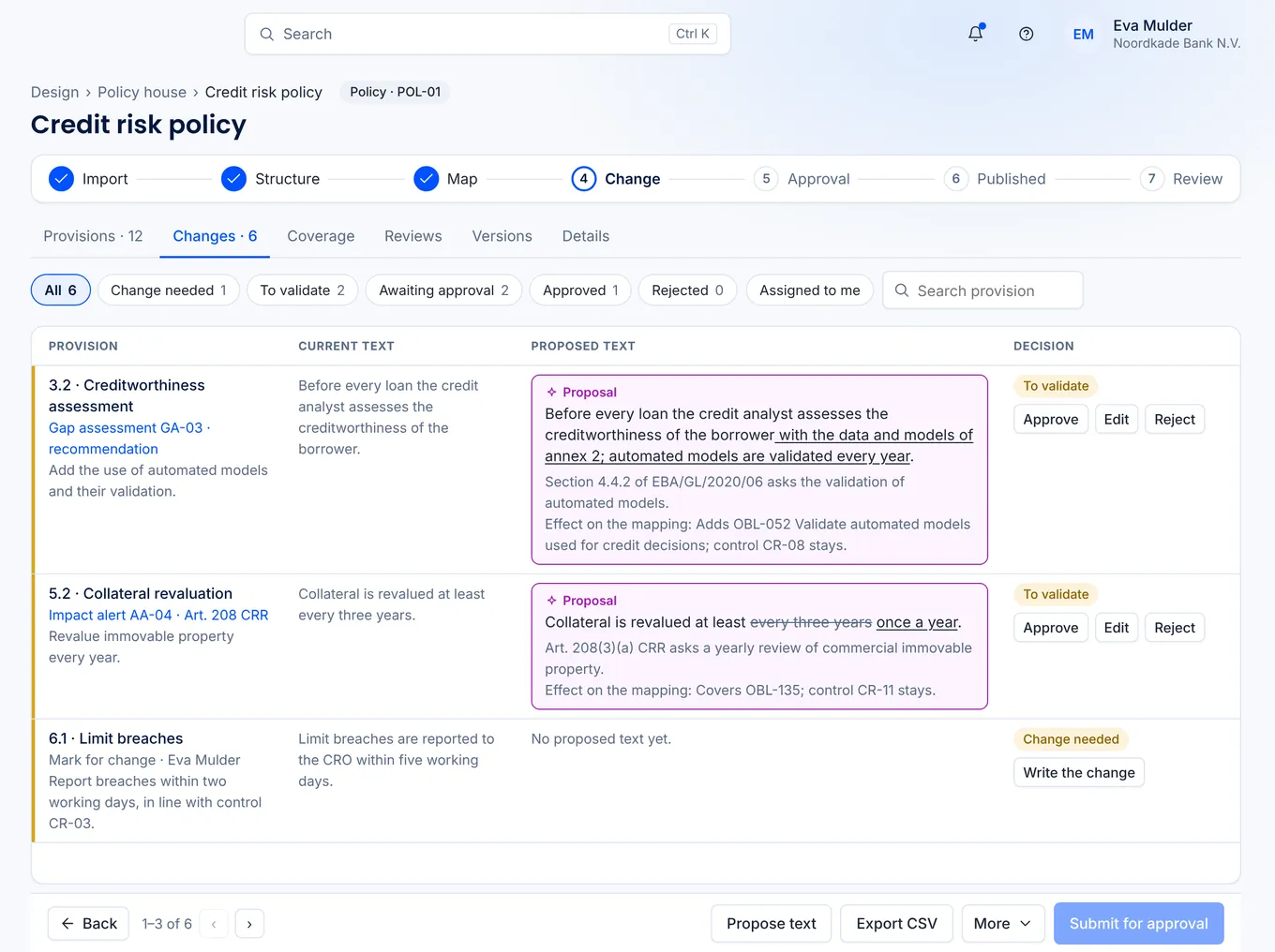
For each affected control or policy provision the owner sees the provision in the current and the new version, the obligation and the impact the platform proposes. Below it is the lineage: provision, obligation, control, risk and policy.
Test your policies or the controls of a control framework against the framework or directly against legislation. For each obligation you see the finding, the quote from your document and a recommendation.
An affected provision gets the status Change needed. The platform proposes new text, with the reason. The validator approves, edits or rejects. The approver signs off the new version.
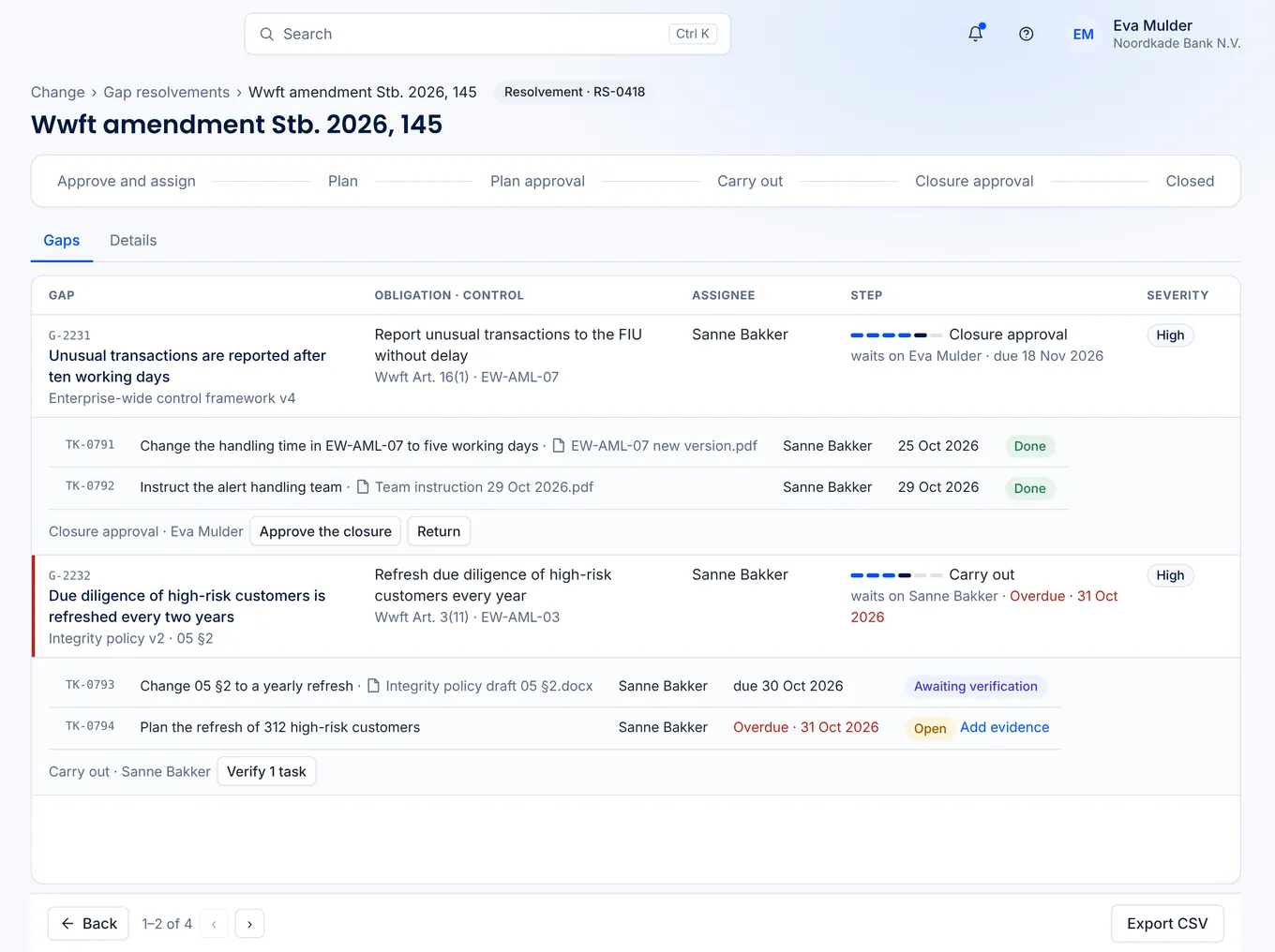
All gaps from one change are in one resolvement. Every gap follows the same steps: assign, plan, approve the plan, carry out, approve the closure, closed. With tasks, a deadline and evidence.
Who it is for
Build the framework, assess alerts and make sure every gap is resolved.
Read moreSee per risk which controls cover it and which control framework they come from.
Read moreDecide on their own alerts and changes, from their own work list.
You choose
Each module is a complete product. You choose your own modules and expand when you are ready.
Signal
Signal is the basis: its profile and legislation are the starting point of your framework.
Signal + Trace
Signal and Trace: you direct the change and make changes in a single step.
Signal + Trace + Prove
With Prove every control gets a test definition and you see whether the change works.
Trace builds on Signal, and Prove on Trace. Your setup stays in place when you expand. Starting prices are for the Small tier, excluding VAT.
Calculate your pricePrice
Trace comes with Signal. The tier follows the number of named users in the platform and does not depend on the number of laws. You set it up yourself, or with the support of our experts.
Small
€ 12,000
up to 15 named users
Medium
€ 40,000
up to 40 named users
Large
€ 85,000
unlimited named users
Per year, 2026 list prices, excluding VAT. With Signal. Ten extra named users: € 4,500 a year.
[citaat]
Questions
The first step
Try the platform for two weeks with real legislation, news and alerts. Or see in thirty minutes what it does with a law from your own scope. For either, contact us.
Assurances you can check on this site