Signal
Know what changes
Signal supplies the changes that trigger a check of a test definition.
Starts with the regulatory change teamFrom € 5,500 a year
Cookies. This site does not measure visits and sets no marketing cookies. In your browser we only store your language choice and the fact that you closed this notice. Cookie policy

Show that it works
Prove links every test to the control, the obligation and the article it counts for. Your compliance requirements and your actual controls then match. When a requirement lapses, so does the test. The lineage runs from the evidence back to the regulatory obligation, for the second line, the third line and the supervisor.
What changes
The test plan
New requirements are added. What lapsed stays because nobody knows where it came from.
additions onlyThe evidence
What is missing only shows when the auditor asks for it.
too lateThe rationale
Why a control is tested, and with which sample, has to be explained again every time.
every timeThe test plan
Every test is tied to a control and an obligation. When the obligation lapses, the test lapses.
what the law requires nowThe evidence
The control owner sees what is asked and by when. Missing evidence stands out.
on timeThe rationale
From the evidence back to the article: definition, sample, conclusion and review, with name and date.
lineage to the lawBenefits
Prove records the test result against the obligation. For each article you see what is covered and what demonstrably works.
Frequency, testers, reviewer and due dates per year, with tasks and reminders per owner.
For every test you see which evidence is in and what is missing. Missing evidence shows up before the audit.
The tester does not review. The reviewer sees the evidence. Four eyes, without exception.
The test result is recorded against the control, the obligation and the risk. For each article you see what demonstrably works.
When an obligation lapses, the control and the test leave the test plan. You test what the law asks now, not what was added over the years.
Sample, evidence, conclusion and review can be traced back to the article. The second line, the third line and the supervisor see why a control exists and that it works.
In four screens
The tester does not review. The reviewer sees the evidence. Every step records who did what.
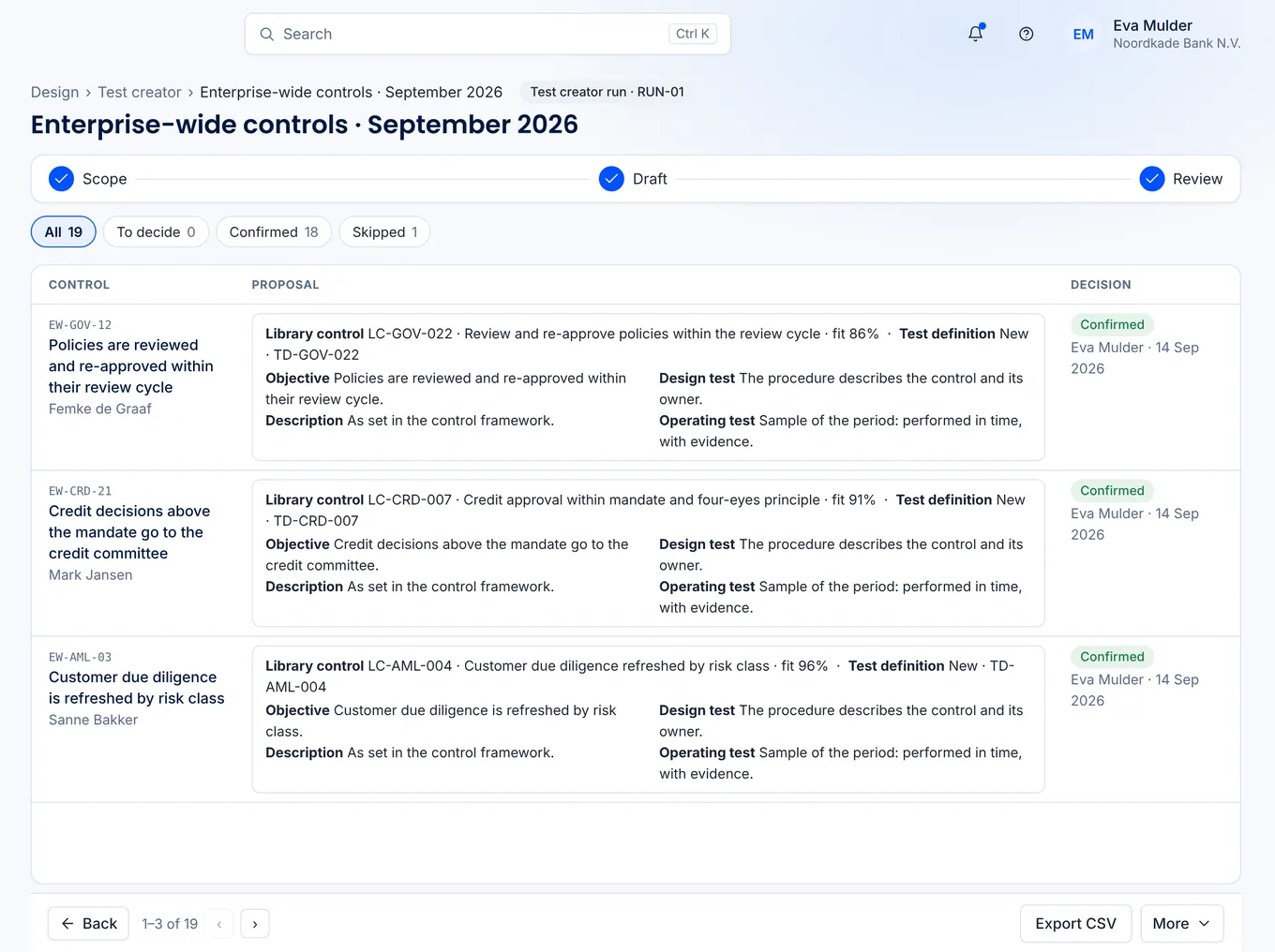
The Test creator proposes a design test and an operating test per control from the Control library. You confirm or edit.
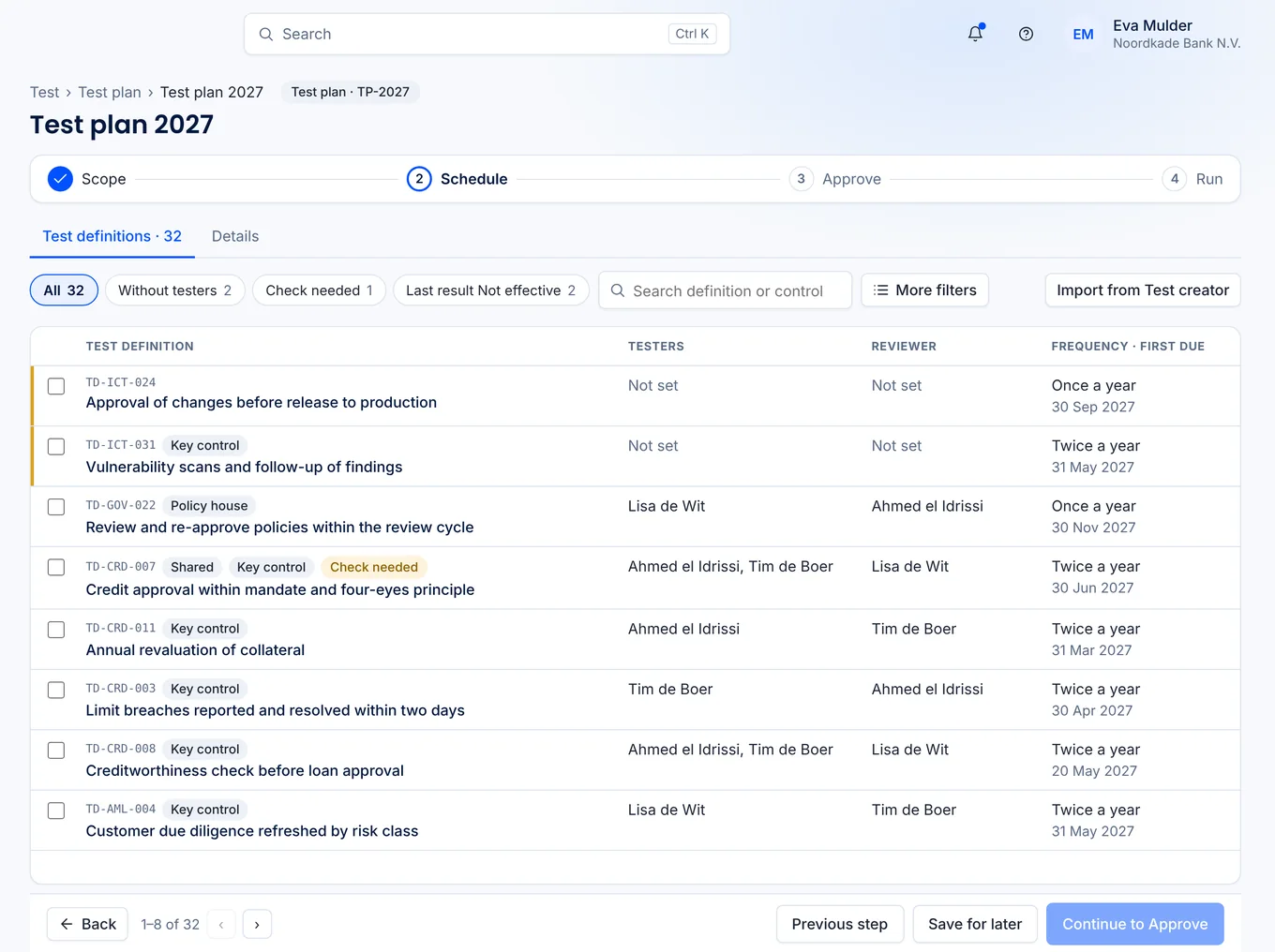
One plan per year: per test definition the testers, the reviewer, the frequency and the due date.
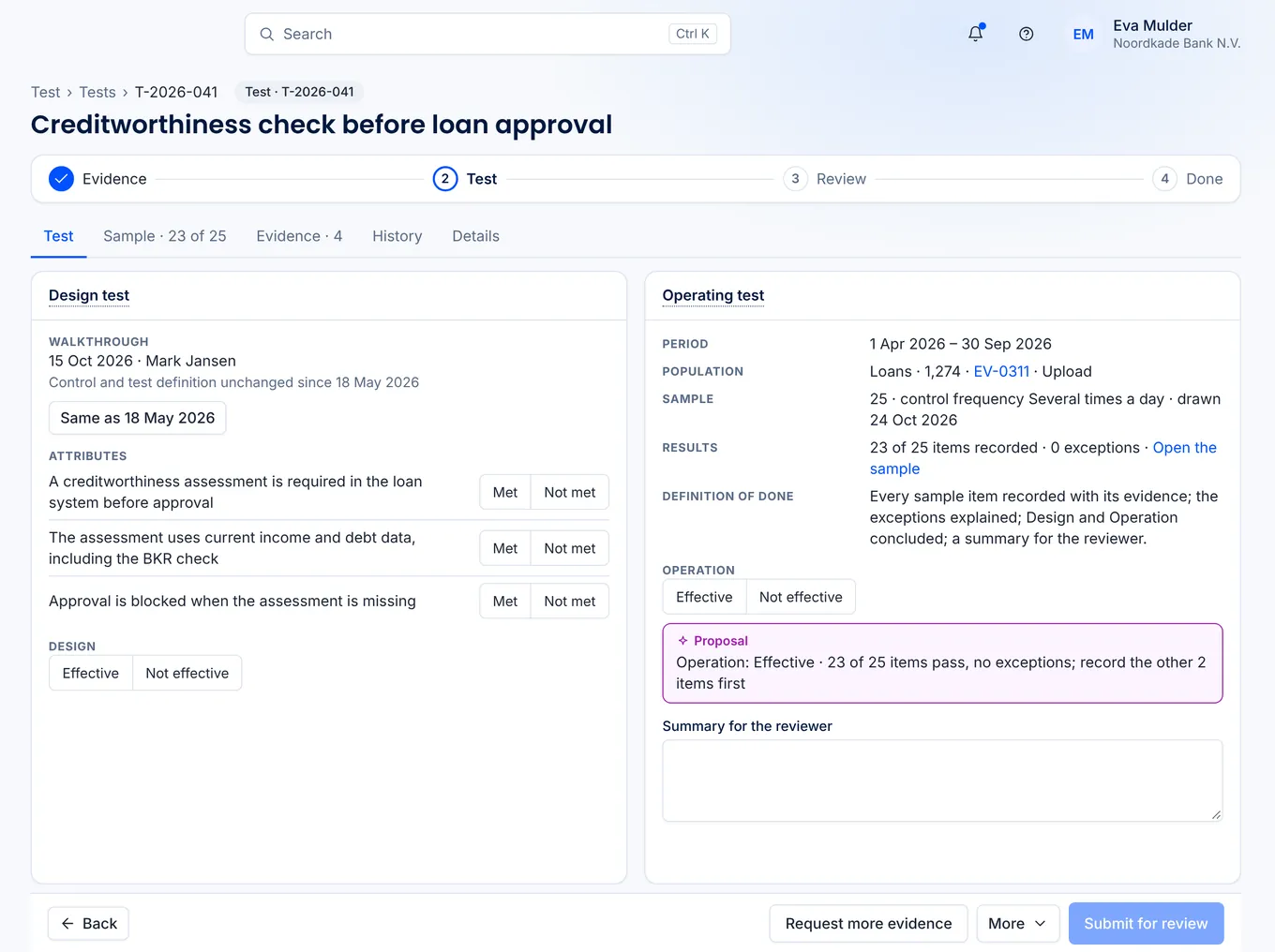
The testers assess the evidence, record the outcome per sample item and conclude. The platform proposes a conclusion.
Upload or SharePoint link. A test keeps the version it used. The test report is frozen.
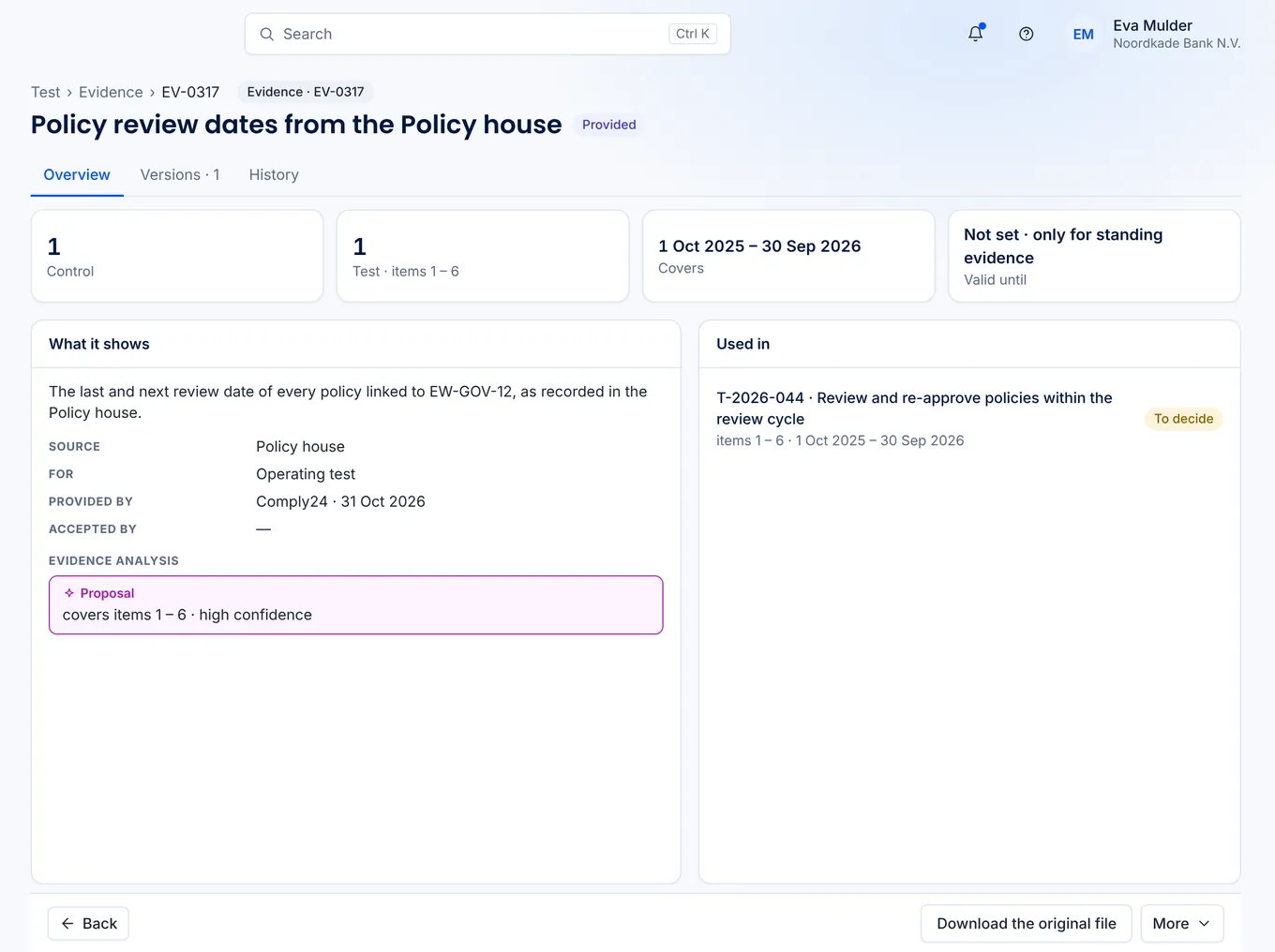
Try it
The platform proposes a conclusion based on the results and the evidence. The tester validates, a reviewer approves. A test that fails becomes a gap in Trace.
Back from the evidence
An auditor or supervisor starts at the evidence and works back: test, control, obligation, provision. Every link shows what was approved, by whom and when.
Swipe sideways for all eight links.
Law
Capital Requirements Regulation as amended by Regulation (EU) 2024/1623. Loaded per article and paragraph, including versions. A new version shows the difference per provision.
Provision
A default occurs when the obligor is more than 90 days past due on a material credit obligation.
Obligation
Derived from the provision with the citation attached, merged with the same requirement from the EBA guidelines and approved by the expert.
Control
The system flags obligors more than 90 days past due. The workout team reviews them within five working days.
Risk
From your own risk register. The gross risk is high. The net risk follows from the test result of the control, not from its description.
Policy
The policy provision that covers the obligation. A new version of the law affects this provision only, not the whole document.
Test
Sample of 25 obligors from the third quarter. Two conclusions, design and operation, and a review by the second line.
Evidence
Recorded with version, source and time. The test report is frozen. From the evidence you can trace back to the article it relates to.
Prove on screen
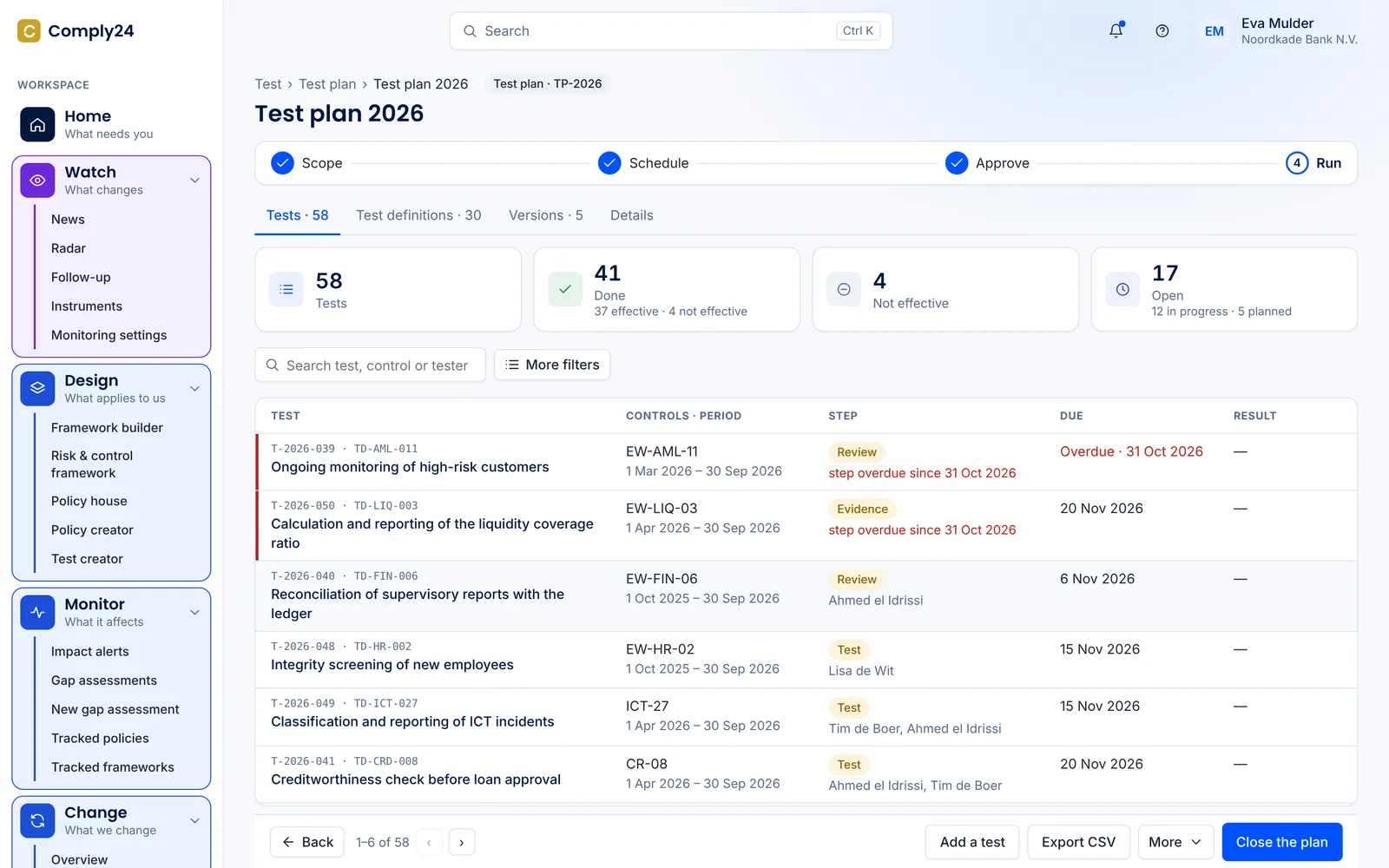
Every test definition shows its lineage: the provision, the obligation, the control and the line in the test plan. So you know for every test which requirement it counts for.
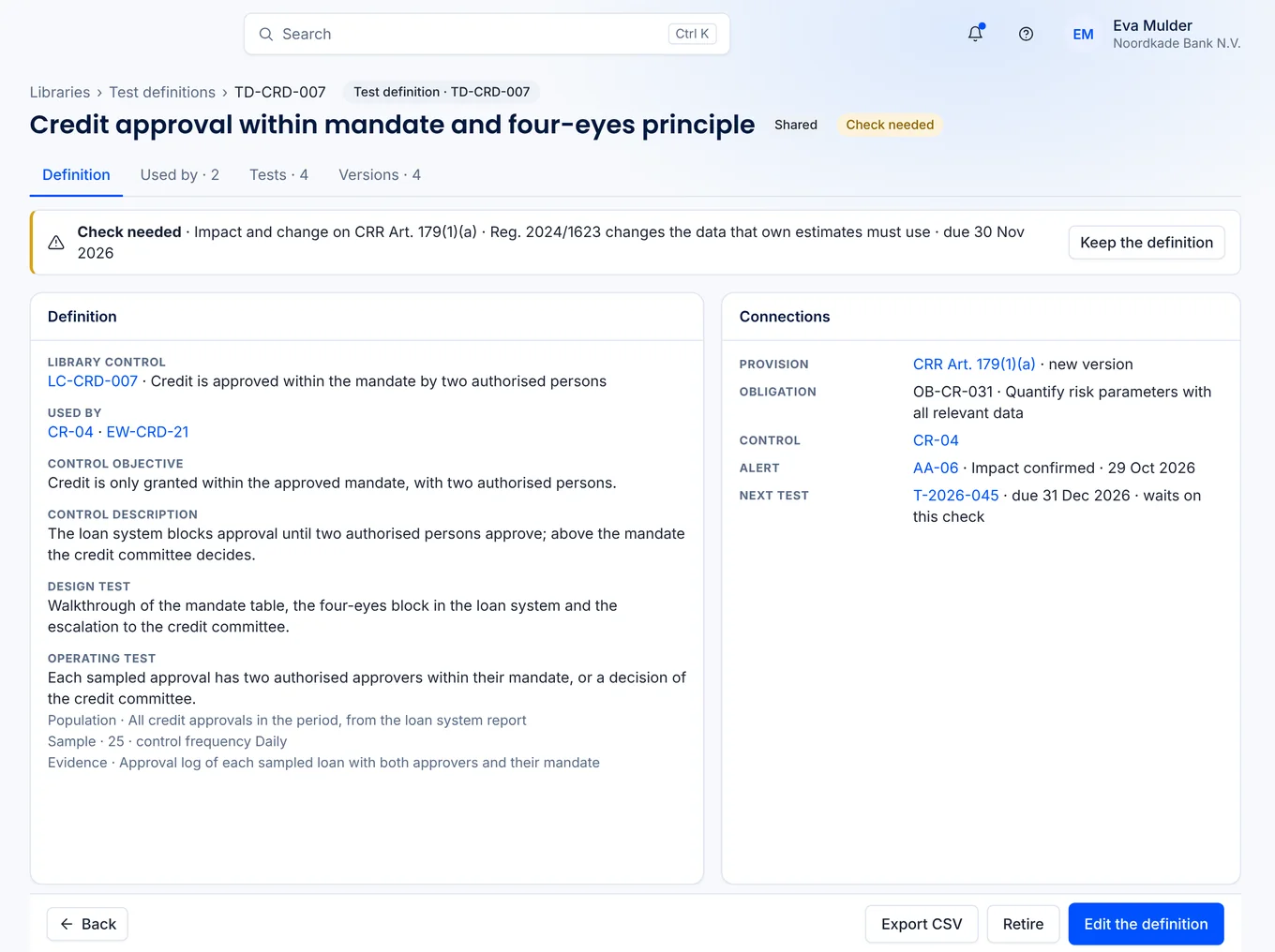
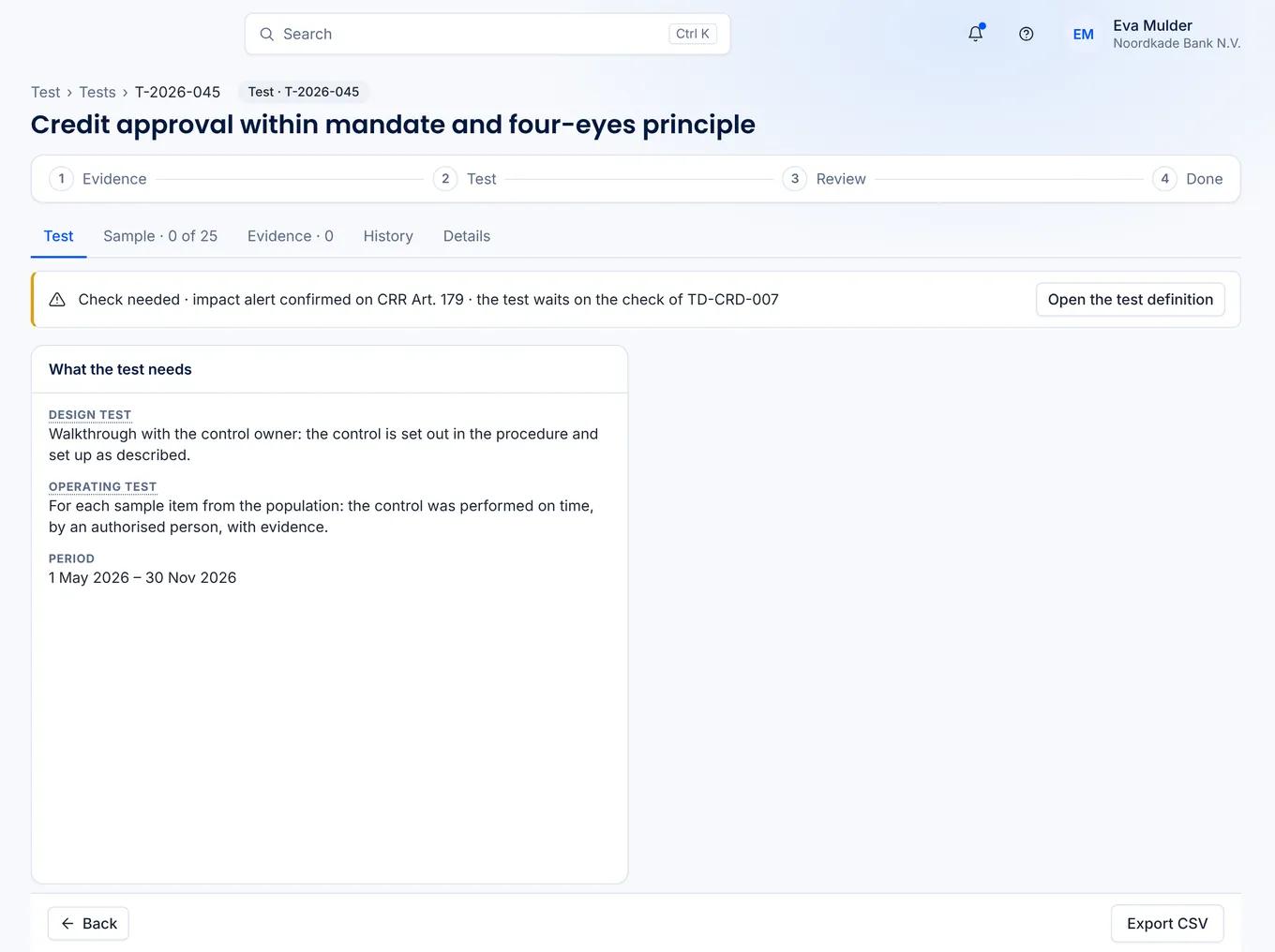
When an impact alert on an obligation is confirmed, the test definition of the control gets the status Check needed. The next test waits until the testers have checked the definition.
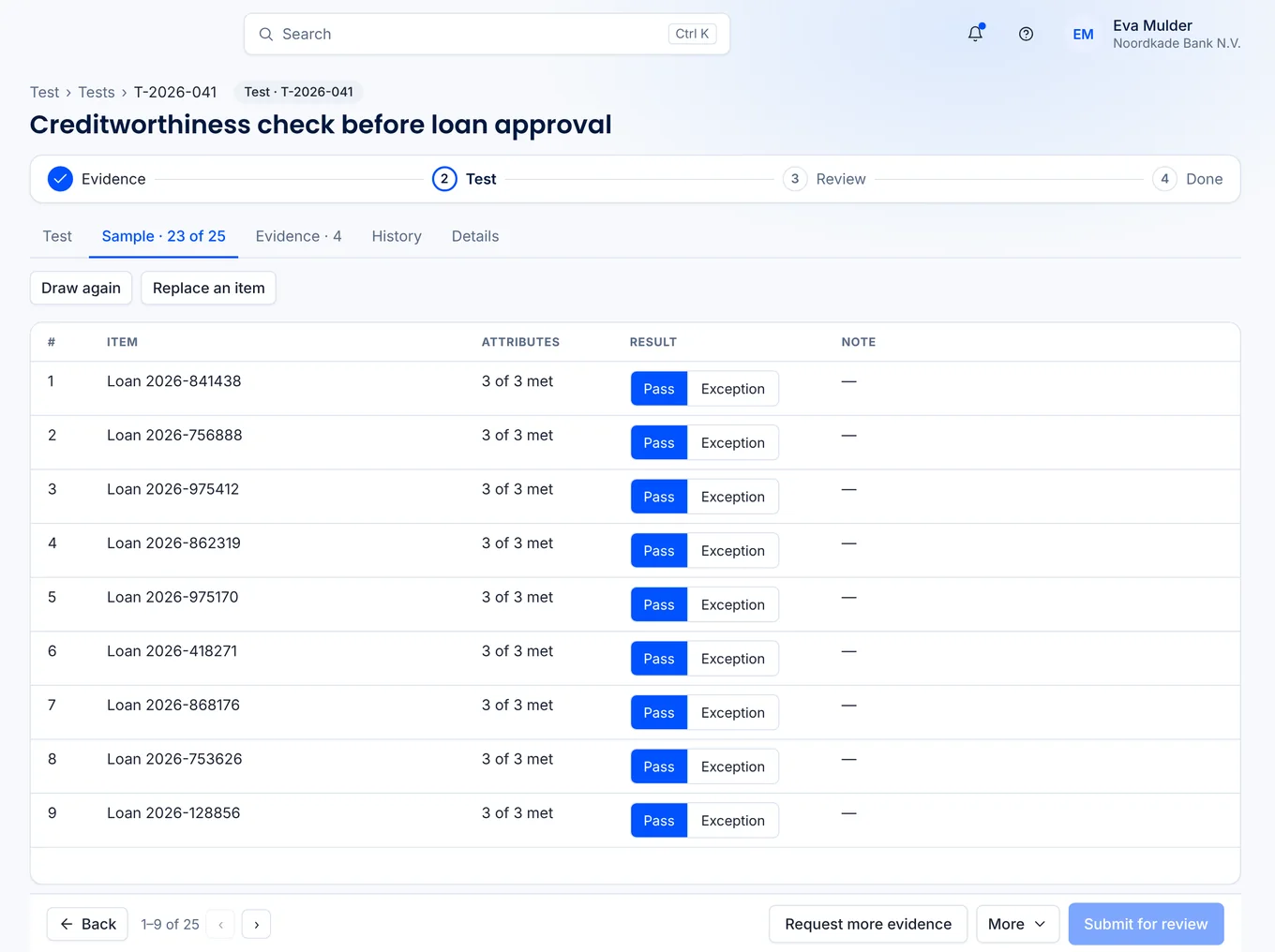
The platform draws the sample from the population the control owner provides. For each item the tester records Pass or Exception. An exception requires a note.
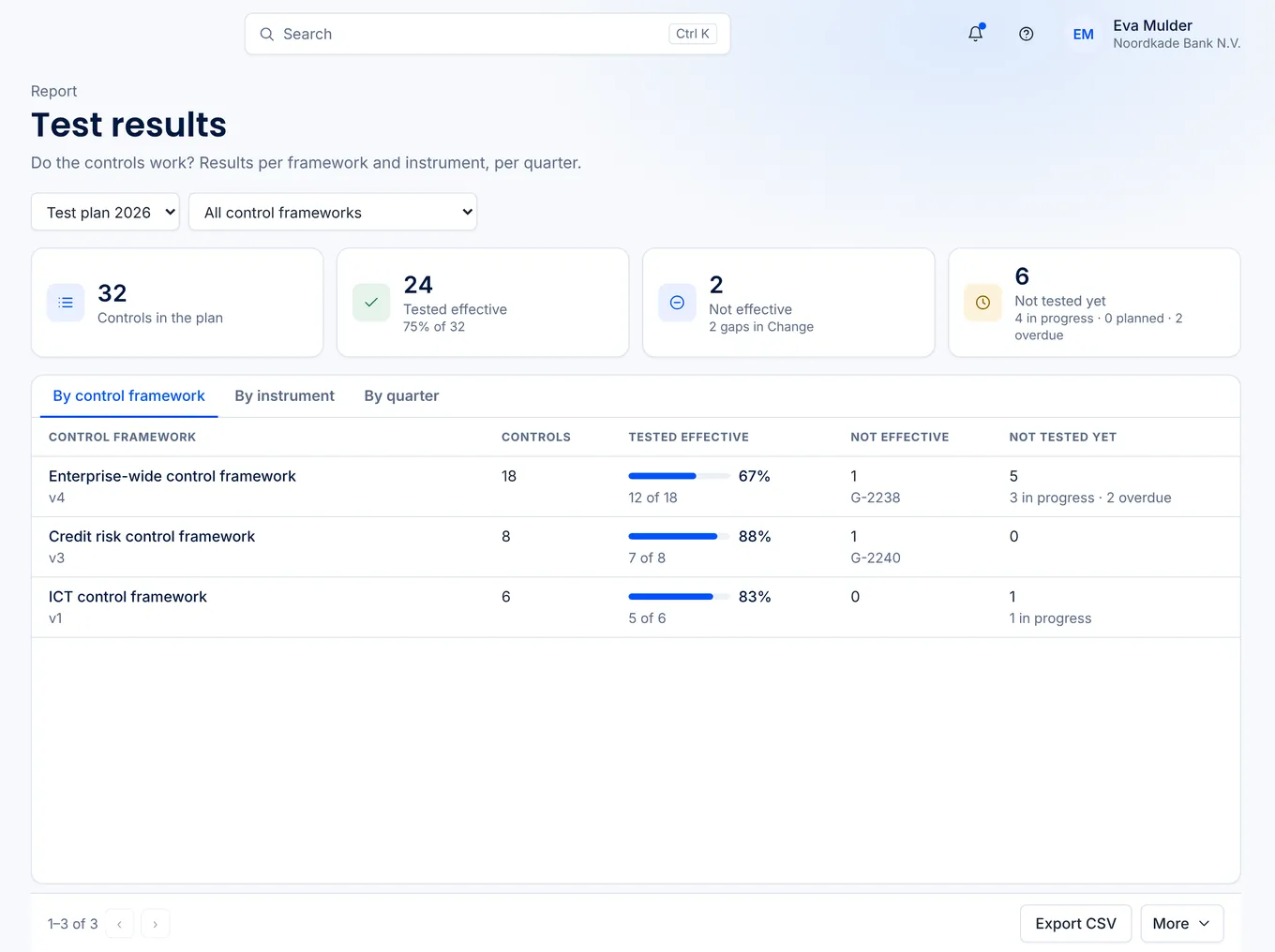
Test results shows the share of controls tested effective, what was not effective and what is still in progress. A row opens the tests behind it.
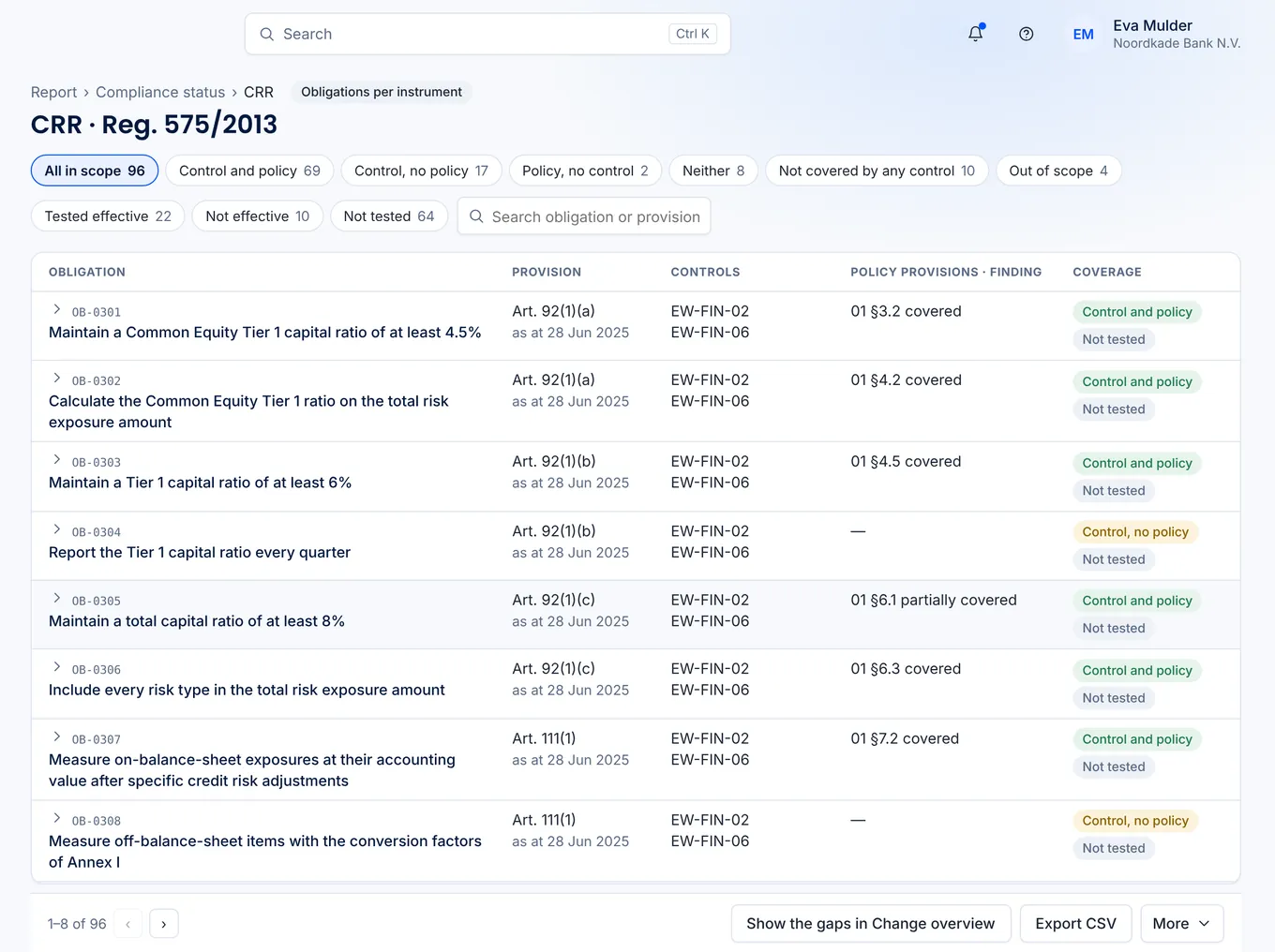
The compliance status shows, per article, the obligation, the control, the policy provision and the test result. Requirements and actual controls are in one list.
Who it is for
The net risk follows from the test results. The test plan follows the law.
Read moreSample, evidence, conclusions and review can be traced. The test report is frozen.
Read moreSee in their own work list which evidence is requested and which test is waiting for them.
You choose
Each module is a complete product. You choose your own modules and expand when you are ready.
Signal
Signal supplies the changes that trigger a check of a test definition.
Signal + Trace
Trace supplies the controls and obligations that every test is tied to.
Signal + Trace + Prove
With all three you show, per obligation, that your controls work.
Trace builds on Signal, and Prove on Trace. Your setup stays in place when you expand. Starting prices are for the Small tier, excluding VAT.
Calculate your pricePrice
Prove comes with Signal and Trace. The tier follows the number of named users in the platform and does not depend on the number of tests. You set up the first test plan yourself, or together with our experts.
Small
€ 6,500
up to 15 named users
Medium
€ 18,000
up to 40 named users
Large
€ 50,000
unlimited named users
Per year, 2026 list prices, excluding VAT. With Signal and Trace. Ten extra named users: € 1,500 a year.
[citaat]
Questions
The first step
Try the platform for two weeks with real legislation, news and alerts. Or see in thirty minutes what it does with a law from your own scope. For either, contact us.
Assurances you can check on this site